This ‘founding text’ of the Festival of Solidarity is the result of a collective drafting process open to all members of the project between June 2018 and June 2019, and was subsequently adopted by the Festisol International Committee in 2022.
In 2024, against the political backdrop of an unprecedented rise in support for far-right parties in the European elections, and with snap general elections posing the risk of handing the reins of power to the far right, this position paper is more relevant than ever. It is also fundamental to understanding the values championed by the Festival of Solidarity project, which stand in contrast to those of far-right parties. The Festisol network continues to mobilise all citizens, to inspire them to take action for a fairer, more united and sustainable world.
The members of the Festival of Solidarity aim to promote the inseparable link between the local and international dimensions of solidarity.
Solidarity is based first and foremost on a reality: whether at the level of a neighbourhood, a village, a country or the world, our lives are interdependent with one another and with nature, and our actions have a global impact. But for us, solidarity is above all a choice: it is deciding to see others as a source of learning, and as a force with which to transform our world together.
DEFENDING HUMAN RIGHTS EVERYWHERE AND COMBATING INEQUALITIES
At a time when inequalities are constantly widening, emphasising human rights is more essential than ever. We put forward a simple yet powerful principle: every human being, wherever they may be and whatever their age, must have all their rights guaranteed, as set out in particular in the Universal Declaration of Human Rights.
Whilst inequalities exist on an international scale, they are also evident within each country. Movements for solidarity are active at every local level and must be able to unite to expand and strengthen the impact of their actions.
Capitalist production models based on the pursuit of profit through the exploitation of people and nature, our consumption habits, and many current public policies reinforce social, economic and environmental injustices, which are closely interlinked. These injustices primarily affect the most vulnerable and marginalised populations. Transforming our economy and strengthening national and international mechanisms for the redistribution of wealth is therefore an urgent necessity, in order to reduce inequalities and better protect the environment.
Global interdependencies are clearly highlighted by migration. Whether they are fleeing an unbearable situation or simply aspiring to a better life, ‘migrants’ or ‘expatriates’ illustrate the age-old and ever-renewing links between different regions of the world. We regard viewing migration as a problem as an aberration, all the more so as it enriches both host countries and countries of origin culturally and economically. The rights of migrants must be defended, regardless of their origin or status.
FOR A GLOBAL AND SOLIDARITY-BASED
CITIZENSHIP
Taking a clear-eyed view of the world leads us to this obvious conclusion: solidarity only makes sense if it is global. Restricting it to a single territory, nationality, culture or religion would only fuel conflicts and divisions. In our view, building peace means recognising the equal right of every human being to live with dignity in a preserved environment.
As well as being global, solidarity must also be civic: we champion the idea of democratic public policies developed and implemented with the involvement of everyone. Being a citizen is not limited to exercising one’s right to vote or freedom of expression: our consumer choices, our savings, our voluntary or professional commitments, and, more broadly, our way of being and our relationship with others, are just as crucial.
Working towards a more united world,
means choosing to defend human rights and to promote, everywhere
,
the values of openness, mutual support, justice and peace.
We are convinced that change will come about through the networking, at local, regional, national, continental and global levels, of all those who share these values. We believe that such networking is essential for raising awareness and mobilising people, diversifying the forms and contexts of these efforts, and strengthening solidarity-based alternatives and advocacy work. Across the globe, we must call on governments to honour their international commitments, in particular the United Nations 2030 Agenda ‘Transforming our world’ and its 17 ‘Sustainable Development Goals’.
Acting together
To successfully transform our societies, we need everyone: public authorities and local authorities, elected by the electorate, but also organisations, educational institutions, businesses, the media, trade unions, and all citizens. Whether at local level or within the framework of international partnerships, it is the shared identification of objectives, the sharing of responsibilities and collective evaluation that ensure the robustness and sustainability of the actions implemented. This requires a transparent and reciprocal relationship, one that is long-term and promotes the autonomy of each individual.
Leaving no one behind
Involving all citizens means taking the time to engage everyone – particularly young people – in understanding the issues at stake, and to develop and implement solutions together, with a view to collective empowerment. Rejecting moralising or guilt-inducing approaches, our awareness-raising activities encourage the expression of diverse opinions and seek to involve those affected by the issues addressed. They aim to deconstruct our perceptions of ‘the other’, whether near or far, and to equip us all with the means to understand how the world works and how we can influence it.
Solidarity: a vision for humanity
Whatever form of engagement is chosen, it must be informed by a comprehensive understanding of today’s world and the changes currently taking place.
Let’s work together for a world built on solidarity!
Download the position paper in PDF format
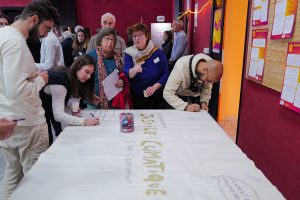
Photo credit: Rémi Déprez.