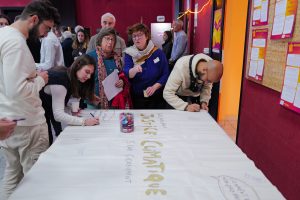
As part of an exchange programme between MCM and Terrafrik Guinea, we interviewed Barry Alpha Oumar, a young Guinean slam poet and member of Terrafrik Guinea. He is taking part in the Festival des Ados Super Chiants, where he is representing Guinea as part of a programme promoting intercultural understanding and citizenship education.
Barry Alpha Oumar, known on stage as Aob Le Khalife, uses slam poetry to champion the environment, people’s rights and gender equality. His journey blends a poetic heritage, personal experiences and collective activism within Terrafrik.

A poetic legacy and a sense of civic responsibility
Poetry is a long-standing tradition in my family. My namesake always told me that my great-grandfather was a great poet whose works can be found in French museums. Yet this had become a taboo subject in our family. As a child, I was already writing poems at school and putting on plays, but I’d stopped because my family were worried I’d take up music. Recently, now that I’m independent, I’ve shown them that slam isn’t just music: it’s a powerful way to champion good causes, such as human rights, the environment or gender equality. They’ve come to understand this and now support me. So slam and poetry have been part of my life since childhood, and I’ve grown up with them.
I am committed to the environment, human rights and gender equality. I use art as a means of expression, activism, raising awareness and education. This art takes the form of slam and poetry.
Understanding inequalities to get more involved
I believe the world is perfect; it is human beings who are imperfect. Today, we are all free and equal before the law, but this principle is not respected: certain groups consider themselves superior and oppress others. I was one of those oppressed young people who went through so much in Guinea. We haven’t always been free. We mustn’t sit idly by: we must take up the struggle, just as those who came before us did. It’s our turn to carry on the fight. Poetry speaks beautifully of nature or love, but we also need poetry that takes a stand. I told myself: you’re an artist, but not just any artist. You have to be authentic and fight for the right cause, because others want to speak out without having your expressiveness.
From personal experience to collective commitment
In 2019, I was a victim of child abuse. I suffered greatly as a result and couldn’t complain, because my parents didn’t understand me. That changed something inside me. At school, I realised that the best way to cope was through writing. That’s also where my commitment began. Through writing, I was setting myself free. Perhaps others are going through the same thing without being able to express themselves. I wrote about it: bit by bit, people started noticing me on social media. I didn’t stop there. A little girl was going through the same thing: I wrote for her, about gender. That’s how I met Terrafrik, thanks to Alpha Idy Balde, my university lecturer. He spoke to me about citizenship education and international solidarity. We said to each other: let’s turn your socially conscious art into a professional endeavour and work together. We’ve been working together harmoniously for five years now. At first, I was full of doubts for three years. Then, once I took the plunge, I saw that it was bearing fruit. I practise slam poetry differently: I’m institutionalising it, I’m professionalising it. That’s what has brought me here.
This experience has also enabled me to support other young people: I’m not alone – there are several young people working alongside me. Today, I’m training young people in Guinea in solidarity and global citizenship, as well as on gender and intercultural understanding, through slam poetry. Some of them are even more skilled than I am. You’ve got to admit it!
Taking collective action through citizenship education: Terrafrik, a solidarity network
Terrafrik is a charity and a network dedicated to solidarity and global citizenship. It promotes cross-cultural exchange and operates in several countries, including Guinea. I discovered it in 2021. At first, I was a bit unsure, but I gave it a go, I enjoyed it and I carried on.
I worked as a programme officer and project manager at Terrafrik before being recruited by a French charity to oversee field operations for an environmental project. Today, I am a member of Terrafrik, where I play a cultural and intercultural role. I work on the international stage to promote Guinean culture, Guinean education and our values.
Exchanging perspectives to challenge extractivism
It was against this backdrop that a joint project with the Festival des Solidarités was launched, focusing on interculturalism and the arts, and run in the Pays de la Loire region by the MCM and the ‘Ados super chiants’ collective. In Guinea, we realised: you’re fighting the same battle but taking different paths. By joining forces, we can create something extraordinary. And so this programme on citizenship and international solidarity was born, a collaboration between the Ados Super Chiants festival and our team in Guinea. That’s why I came: we worked intensively for a week, and I’m continuing the work with Bellarue 17 Studios. Our work will bear fruit.
We met the MCM team in 2024. They were in Guinea; I was in Slamais. Our discussions led to a programme on extractivism, peoples’ rights and the environment. I was due to go there in 2024, but travel procedures complicated matters. We refocused our efforts: we created a 30-minute show on extractivism for the 2024 edition of the Festival des Solidarités, in which I played the lead role. We didn’t stop there: we continue to speak out and, from time to time, succeed in our cause. The idea is one of reciprocity, of sharing perspectives: sending Guinean slam poets to France. Everyone experiences these issues differently; by highlighting them for one another, we’ll achieve results. Beyond extractivism: peoples’ rights, gender, and migration.
From local issues to global impacts
These issues intersect in Guinea. Extractivism – the illegal or excessive exploitation of our land at the expense of local communities – is destroying the environment. This has an impact on the health and social well-being of communities, driving young people to migrate elsewhere in order to survive. We have therefore adopted an intersectional approach to establish the links between extractivism, migration, gender-based violence, etc., whilst also adopting an ECSI approach. These are sensitive issues, but we must be able to name them: it is the causes and consequences of extractivism that drive climate change, the destruction of the environment and biodiversity, and consequently migration. This is the foundation: let us speak out, raise awareness and take action. Extractivism, the environment and migration are inextricably linked.

Artistic expression as a tool for raising awareness
We highlight realities, explain them and foster collective awareness. Art is the most accessible way to convey these messages and evoke the necessary emotion. We have done so with great conviction.
You can say to a president, ‘We disagree’, and he can hear it and accept it. Only art allows for that. In political debate, laws and conventions can stifle discussion; as artists, we enjoy a certain freedom of expression. We highlight problems and also propose solutions. With the support of partner organisations and funding, we can put these solutions into practice. It is a clear and concrete process.
Trends towards change are already underway
Yes, there have been some victories. In Guinea, the current regime is investing in the environment – not in Simandou, but in the conservation of endangered species through conservation projects and the establishment of corridors to preserve biodiversity and the environment, with the involvement of local communities. This gives us hope: it’s a start, a path has been laid out. It takes time, but let’s keep hope alive and carry on the fight.
On the international stage, this is a step forward. I am referring to the World Social Forum in Benin, which I will be able to take part in via Studio Belarus 17, MCM, Terrafrik and CRID. We will be discussing extractivism, the environment, biodiversity, gender and peoples’ rights. Leaving the European ‘North Pole’ for West or North Africa, sharing our vision, bringing together 1,000 to 2,000 young people around a common theme, with workshops, discussions, education, awareness-raising and concrete action: this will move things forward. That is my hope.
Empowering young people
Young people are the future. Without their involvement today, in the face of technology and the frenetic pace of the world, these highly intelligent young people will be left behind. Young people have skills and vision, but they need encouragement and guidance at the outset. We are suffering from these problems; we are their victims – and sometimes the culprits, through ignorance or thoughtlessness. Without us, nothing will move forward.
I urge young people here and elsewhere to take action in their own fields, not necessarily through art or slam poetry. Every young person can take action to make a difference, to fight against extractivism, and to defend people’s rights and the environment. Let them take action without waiting for a helping hand: take that first step, and the world will support them. That is my message.
Removing barriers to ensure fairer action
Yes, there are constant obstacles. When you’re speaking out or leading a campaign, you can’t do it alone. You need a strong team that can support you, whether financially, technically or administratively. We saw this at the 2025 Festival of Solidarity in November. I was due to come and open the festival with a short performance. But I had an administrative issue in Guinea which delayed my visa, so I wasn’t able to make it. And that held up the programme. Fortunately, the second time round, they understood my situation and granted me the visa. But there are plenty of young people today who are speaking out in the same way, fighting the same cause, yet who don’t have visas or face administrative problems that prevent them from continuing what they’ve started. Some get discouraged and give up; others try to stay hopeful and carry on doing what they have to do. So, this is what I have to say: on our own, we cannot do it, but together, we can. But we need financial resources; we need technical, administrative and professional support.
Working together, across borders
In 2024, we created a performance exploring the issue of extractivism. For three months, young people worked together as part of a writing residency, with the aim of producing a collaborative piece. We thus presented a performance lasting around 30 minutes, performed entirely by young people.
Up until now, everyone has been working more or less independently, even though we share the same objectives and focus on the same issues. The challenge now is to take things further by bringing these different approaches together to give them greater momentum. In particular, this involves linking the work carried out in Guinea, in Conakry, with the initiatives developed here, in order to build something more collective and impactful.
It was with this in mind that we met the ‘Ados super chiants’ team. The name often provokes a reaction, but it’s quite telling: on stage, they’re direct, straightforward, and tackle sensitive subjects by getting straight to the point. In a way, that’s what we’re trying to do too: not sidestepping problems, but rather shining a light on what’s troubling, right where it hurts.
In this context, it was important for me to speak on behalf of my team in Guinea and to come to Nantes to work with the ‘Ados super chiants’ group. We spent a week together, which was full of discussions and new experiences.
On the programme: cultural workshops, studio recording sessions, singing, as well as sophrology workshops — a practice I knew nothing about and which I found very beneficial. We even put on a mini sophrology performance as part of the programme, which was a first for me.
For my part, I also performed a solo show over several days, exploring themes that are particularly close to my heart: the environment, gender, immigration, interculturalism and the rights of peoples. It was also a first for them to see a young Guinean tackle these issues on stage. So there was a genuine exchange: I learnt from them, and they learnt from me.
The idea now is to build on this momentum. In July, the young people we met in Nantes are due to come to Guinea to work with my team, create together and develop other artistic activities: theatre, percussion, singing… Then, in a second phase, we’d like to enable several young people from Guinea to come to France in turn, particularly as part of the Festival des Solidarités, to present this joint project.
This is a project we are building step by step, with the aim of fostering dialogue, bringing different perspectives together and fostering a stronger collective creative process.
I’m calling on all ambitious young people: go for it, don’t let yourselves be intimidated, and do your very best!