From Nantes to Ntoum, and from Kinshasa to Réunion, the 2025 edition of the Festival of Solidarity brought together more than 180,000 people across 14 countries. A look back at a pivotal year.
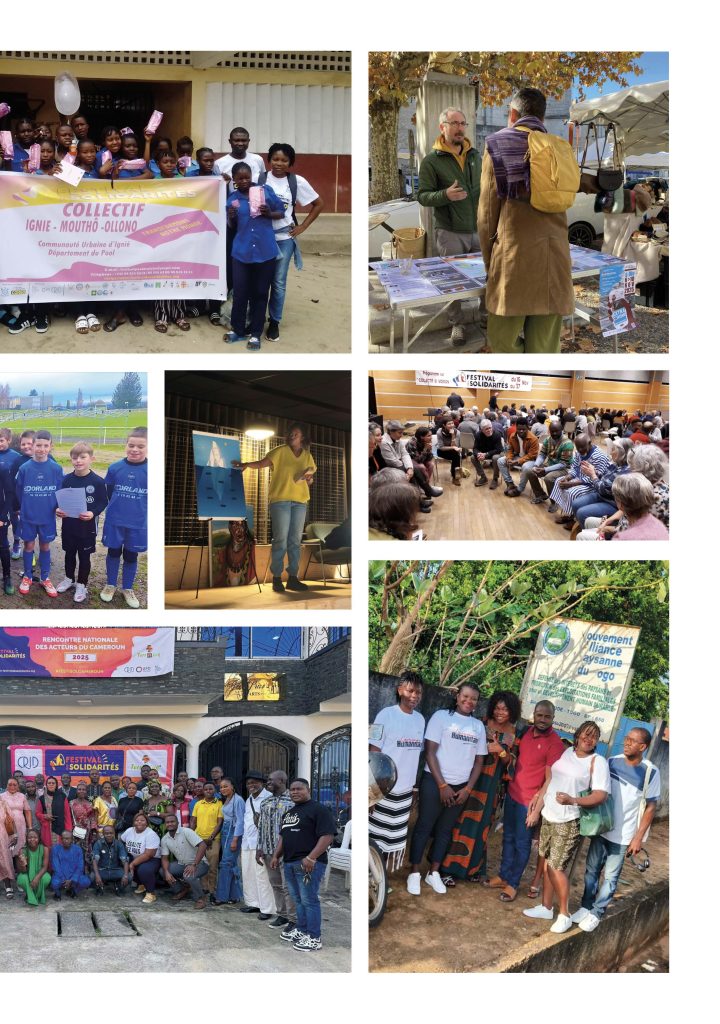
In November 2025, something happened. In a neighbourhood of Libreville, pupils at Léon Mba High School picked up paintbrushes to convey what words alone could not express — a workshop scheduled to last two hours that went on for four, because the children refused to leave. In Ntoum, an hour’s drive from the Gabonese capital, women set up a community vegetable garden whose harvests feed the whole neighbourhood. In Kinshasa, volunteers went door to door, plot by plot, to talk about waste sorting and environmental citizenship. In Agen, a collective took advantage of the end of support for Windows 10 to introduce local residents to free and open-source software. And thousands of kilometres away, in the Itasy region of Madagascar, 2,000 people took part in the very first Malagasy Festisol.
These are not mere anecdotes. They are the threads of a single tapestry, woven by 3,950 organisations across 14 countries, and this is the very purpose of the 2025 review we are publishing today.
An event marked by unity
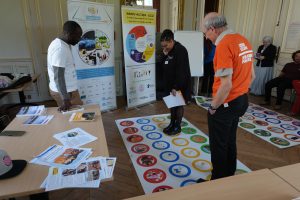
For the first time, this report no longer distinguishes between Festisol France and Festisol International. Not because the contexts are identical — they are not — but because the struggles converge. Short supply chains in Agen address the same challenges as agroecology in Arivonimamo. The extractivism criticised in Nantes is destroying communities in Guinea. The food sovereignty championed in Gabon echoes the farmers’ markets in Lot-et-Garonne.
The ‘Environment and Peoples’ Rights’ focus, now in its second year of a three-year cycle, served as the central theme for this convergence: over 90 per cent of the collectives drew on it to develop their programmes.
The 2025 edition saw the Festisol network expand as never before. Brazil made its debut with 60 activities and 3,000 participants in the state of Minas Gerais. Madagascar held its first festival in the Itasy region. Réunion hosted its very first edition, laying the foundations for a programme of education in citizenship and international solidarity in a region where such initiatives were previously unknown. Fourteen countries are now represented — a record.
Young people at the heart of the movement
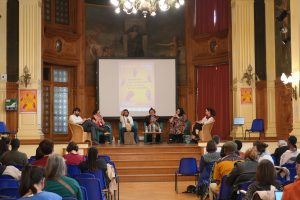
If this report makes us want to believe in this, it is also because it shows a generation that is no longer content merely to participate: it co-designs, co-facilitates and drives initiatives forward. In Réunion, 19 out of 28 volunteers were under 30. In Agen, pupils created educational resources and then delivered the sessions themselves to other classes. In Nantes, ‘Gen Z’ is challenging traditional forms of solidarity and proposing new ones. Everywhere, young people are no longer just recipients: they are active participants.
Taking action even when everything seems to stand in the way
One of the most striking sections of the report concerns the DRC. In Bukavu, in the east of the country where the security situation is extremely tense, a collective has been carrying out initiatives to prevent gender-based violence in schools. In Kinshasa, in neighbourhoods prone to flooding and poor sanitation, volunteers went door-to-door to promote environmental citizenship. This proves that civic engagement does not stop at the boundaries of stability.
A network that is growing and becoming stronger
The figures speak for themselves: over 3,700 events, 191 grants awarded, 350 new partner organisations in France, and 700 new volunteers. But beyond the figures, the report documents the profound changes taking place: local authorities incorporating environmental issues into their policies, new cooperatives being set up, teachers advocating for the long-term sustainability of extracurricular activities, and changing attitudes.
A look back at a year of international solidarity
This report is not an administrative document. It is a journey — from Gabon to Brazil, from the DRC to Nantes, from Madagascar to Agen — to meet the people who, all over the world, are devising practical solutions to the crises of our time. We meet Célestine, chair of the Ntoum collective, who tells us how the children rush to the vegetable garden as soon as school finishes. Nathalie Zemo Efoua, founder of the first feminist network to coordinate Festisol in Africa, who speaks of sisterhood as a force we can rely on. The young people from Réunion, without whom their first Festisol simply would not have taken place.
Twenty-eight pages to understand what is at stake when citizens decide, together, that another world is possible.
[Download the Festisol 2025 report (PDF)]
Assessment carried out in March 2026 by CRID and its partners. Project supported by AFD.